← Back to Teach
Ocean Literacy Principle 2

The ocean and life in the ocean shape Earth

Ocean water, waves, sediments, tectonic activity, sea-level change, and marine organisms continually reshape Earth. They build, break down, move, and preserve materials that become coastlines, landforms, reefs, and rocks.

Guiding question: How do ocean processes and marine life build and reshape Earth?

NMEA grade band: Grades 6–8

Other grade bands are in preparation.

Quiz this principle

At a glance

What students should take away

Students often think of the ocean as water next to land. This principle helps them see that the ocean is also part of how Earth’s surface is built, worn away, changed, and rebuilt over time. That makes later topics easier to teach, including coasts, erosion, sea-level change, tectonics, reefs, sediments, and the long-term role of marine life in shaping Earth.

Key ideas

  • Weathering, erosion, deposition, waves, and storms continually reshape coasts.
  • Sea-level change can expose, cover, create, or remove coastal landforms.
  • Plate tectonics shape the seafloor and many coastal features.
  • Many rocks now found on land originally formed in marine environments.
  • Marine organisms help build reefs and sedimentary rocks.

Teach this principle

Why this matters

This principle helps students understand that the ocean helps shape the planet itself. Coasts, sediments, shelves, reefs, and many rocks on land are connected to marine processes and life in the ocean.

  1. Look at a changing coastline

    Student task
    Use WebGIS or a photograph to identify beaches, cliffs, shelves, reefs, or other features and look for visible evidence of change.
    Ask the class
    What evidence suggests this coastline is changing?
    Listen for
    Waves and storms move sediment, changing the shape of beaches and coasts.
  2. Identify what is shaping it

    Student task
    Ask whether waves, storms, weathering, erosion, deposition, sea-level change, tectonics, or living organisms are shaping the feature.
    Ask the class
    How could sea level or plate movement reshape this coast?
    Listen for
    Changes in sea level and tectonic movement can expose, cover, or reshape coastal landforms.
  3. Follow what happens over time

    Student task
    Ask whether each process is building, breaking down, moving, or preserving Earth materials.
    Ask the class
    How can marine life help build Earth’s surface over time?
    Listen for
    Shells and skeletons can accumulate and contribute to reefs, sediments, and rocks.

Check understanding

Choose one coastal or marine feature on this page. How might waves, sediments, sea-level change, tectonics, or marine life have helped shape it?

Explore the concepts

Coasts are always changingWhere ocean meets land, constructive and destructive processes continually reshape the coast.

Weathering, erosion, and deposition reshape coastlines.

Rocks are broken down by physical, chemical, and biological weathering. Waves, currents, wind, rivers, storms, and gravity then erode, transport, and deposit sediments, changing beaches, cliffs, and other coastal landforms. Sand can contain fragments of rocks, minerals, and organisms, and is continually redistributed by rivers, waves, and currents.

Biological weathering includes organisms grinding or boring into rock. Organisms can also release organic acids that promote chemical weathering. Cracks expose more surfaces where further weathering can occur.

Chemical weathering changes minerals: hydrolysis involves reactions with water, oxidation involves reactions with oxygen, and acids can dissolve susceptible minerals. Physical weathering breaks rock without requiring a change in its mineral composition.

Examples and vocabulary

Sea urchins can wear cavities into rock. Physical weathering examples include water freezing and expanding in cracks, growing salt crystals, pressure from moving water (hydraulic action), pressure release, wind-blown abrasion, and expansion or contraction as temperatures change. Ice and living organisms can also move sediment.

Waves and storms can rapidly change beaches.

Strong waves and storms can remove large amounts of sediment, while gentler conditions can return sediment to beaches. Beach shape therefore changes over seasons as well as over longer periods.

Rivers can replenish beaches with sediment that waves and currents remove. Where winter storms are stronger, beaches may lose sand in winter and rebuild under gentler summer waves; the seasonal pattern depends on the coast.

Connected concepts in other principles

Sea level and tectonics reshape the boundary between land and oceanClimate and movements of Earth’s crust change the position and form of coastlines over both short and geologic timescales.

Changing sea level exposes and covers landforms.

Climate and tectonic activity can change sea level relative to the land. As relative sea level rises or falls, continental shelves, islands, beaches, marine terraces, and inland seas can appear, disappear, or change shape.

Climate changes the amount of water stored in land-based ice caps and glaciers. Melting adds water to the ocean; growth stores more water on land. These volume changes alter sea level, alongside changes in land height.

Marine fossils, ancient coral reefs and former beaches found far inland or above today’s coast provide evidence of past marine environments. Interpreting them requires considering both sea-level change and tectonic movement.

Plate tectonics create major coastal and ocean features.

Where tectonic plates interact, uplift, subduction, volcanoes, earthquakes, and mountain building can reshape coastlines and the seafloor. Tectonic movement can also change sea level relative to the land.

Connected concepts in other principles

The ocean is part of the rock cycleMarine environments form and transform rocks, while marine life leaves long-lasting records in reefs, sediments, and the rocks later exposed on land.

Many rocks now exposed on land formed in ocean environments.

Sediments deposited on the seafloor can become sedimentary rock. Volcanoes, hot spots, mid-ocean ridges, and subduction zones also form igneous and metamorphic rocks in ocean settings. Plate movement can later expose these rocks on land.

Cooling magma forms igneous rocks at submarine volcanoes, hot spots and mid-ocean ridges. At subduction zones, heat and pressure can transform existing rocks into metamorphic rocks without completely melting them.

Marine life helps build rocks and reefs.

Many marine organisms make hard structures from calcium carbonate or silica. Shells, coral skeletons, microscopic plankton remains, and other biological material can accumulate on the seafloor and eventually contribute to reefs, sedimentary rocks, and a record of past life.

Microbial mats, including cyanobacteria, trap and bind sediment and can promote mineral precipitation. Repeated growth and sediment accumulation build layered structures called stromatolites. They preserve an important record of early life over billions of years.

Corals secrete calcium carbonate skeletons that accumulate into reef frameworks. Coralline algae also contribute carbonate. After organisms die, their hard parts can settle, accumulate and become sedimentary rock.

Examples and vocabulary

Mollusk shells, foraminiferal shells and coccoliths supply carbonate material; radiolarian skeletons and diatom cell walls supply silica. Stromatolites record microbial construction rather than a pile of animal skeletons.

Connected concepts in other principles

Teaching resources

Start here

Tool

1. Look for visible coastal change

Use WebGIS with a coast or erosion photograph to identify beaches, cliffs, shelves, and other landforms shaped where ocean meets land.

Opportunity

4. Extend into seafloor geology

Thermal vents show that the ocean is connected to geological processes below the seafloor as well as to life above it.

Explore this principle with the platform

WebGIS

Compare reefs, coasts, shelves, and tectonically active marine regions to see how ocean processes shape Earth.

Knowledge Graph

Trace links among marine life, sediments, coastal change, tectonics, and other Earth-shaping processes.

Cards

Use cards to discuss thermal vents, storm surge, and other examples where ocean and Earth systems interact.
Featured Ecoregions

Red Sea

Ecoregion

Red Sea

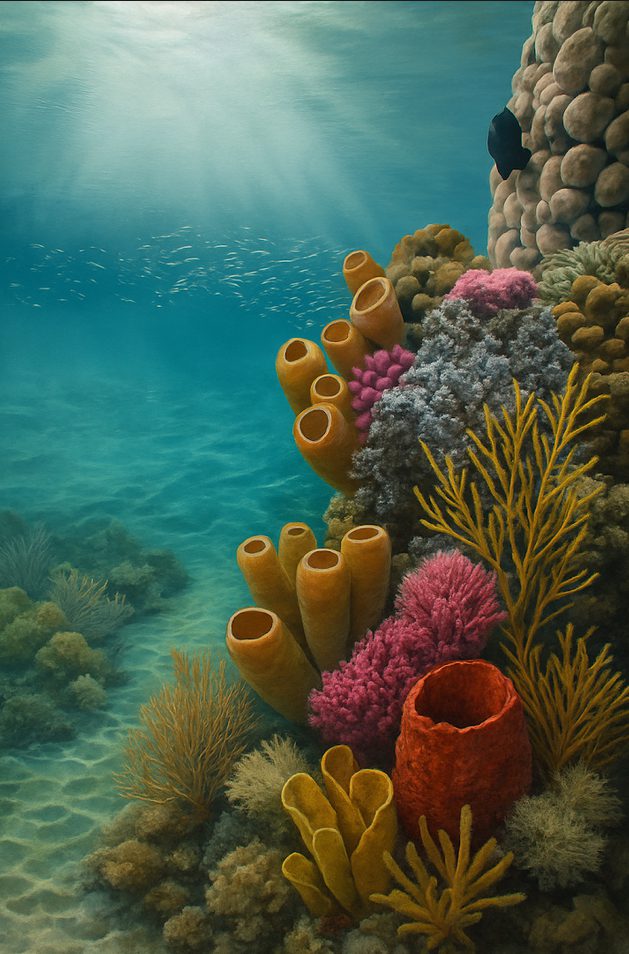
Distinctive: This region reflects a coastline shaped by tectonic activity, basin structure, and marine conditions.

Connected to the global system: It shows how tectonics, sea level, and the ocean work together to shape Earth features.
Great Barrier Reef

Ecoregion

Great Barrier Reef

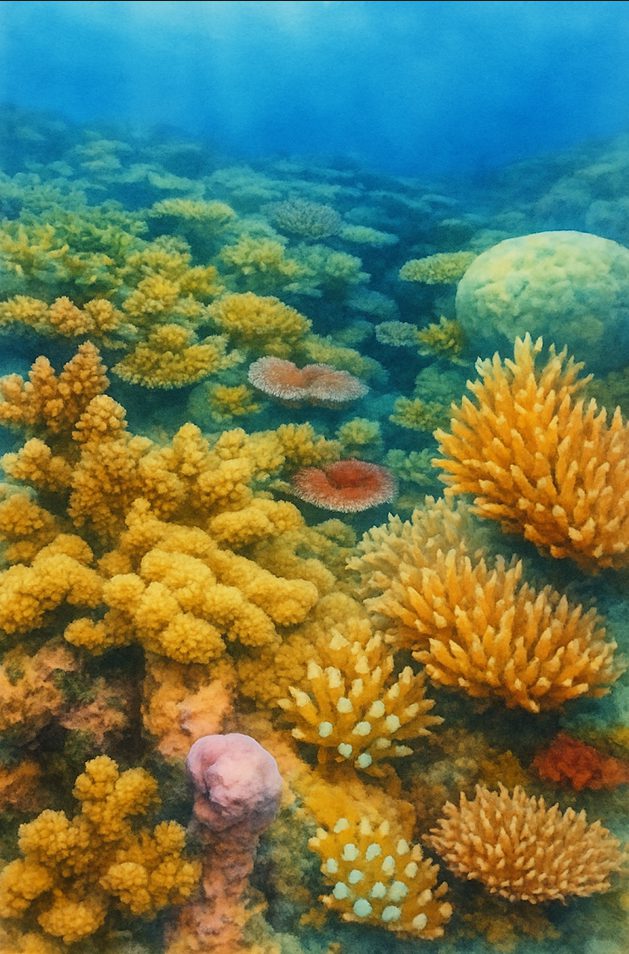
Distinctive: This reef is a large biological structure built by marine organisms over long periods of time.

Connected to the global system: It shows that ocean life can become part of Earth’s physical surface by shaping habitat, rock, and coastal structure.
Featured Cards

Thermal Vents

Opportunity

Thermal Vents

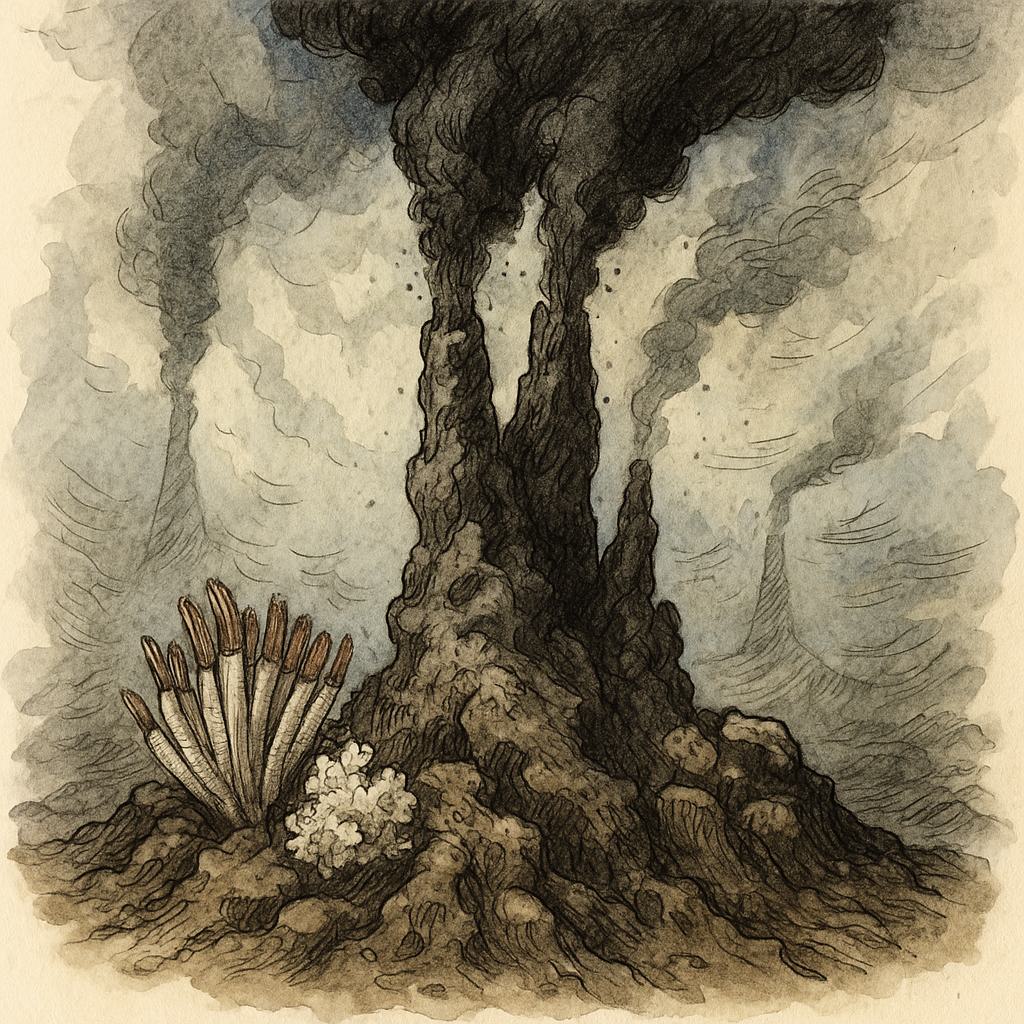
Thermal vents illustrate the principle by showing that the ocean connects directly to geological processes below the seafloor.

Sources and curriculum alignment

Grades 6–8 conceptual alignment: Adapted from NMEA Ocean Literacy Scope and Sequence under CC BY-NC-SA 4.0.

Adapted from the NMEA Grades 6–8 Principle 2 CFD (2021, handbook page 47). Source notes distinguish the original concepts from qualified adaptations. Classroom tasks and platform links are Blue Biome teaching suggestions.

Source concepts and connections

The notes below paraphrase the English NMEA source. They also explain qualified adaptations and corrected references.

A · Weathering, erosion, and deposition reshape coastlines.
  • Many geological changes occur where ocean meets land.
Read the explanation
A1 · Weathering, erosion, and deposition reshape coastlines.
  • Constructive and destructive processes together shape coastal landforms.
Read the explanation
A2 · Weathering, erosion, and deposition reshape coastlines.
  • Physical, chemical and biological processes weather rocks, soils and minerals.
Read the explanation
A3 · Weathering, erosion, and deposition reshape coastlines.
  • Organisms cause physical weathering, as when sea urchins grind rock.
  • Organisms physically weather rock; sea urchins are an example.
Read the explanation
A4 · Weathering, erosion, and deposition reshape coastlines.
  • Organic acids from organisms promote chemical weathering.
  • Organic acids from organisms promote chemical weathering.
Read the explanation
A5 · Weathering, erosion, and deposition reshape coastlines.
  • Cracks make further weathering more likely.
  • Cracks expose surfaces to further weathering.
Read the explanation
A6 · Weathering, erosion, and deposition reshape coastlines.
  • Chemical weathering changes minerals through hydrolysis, oxidation and acidification.
  • Chemical weathering includes hydrolysis, oxidation and acidification.
Read the explanation
A7 · Weathering, erosion, and deposition reshape coastlines.
  • Physical weathering includes freeze–thaw, salt growth, hydraulic action, pressure release, wind abrasion and thermal expansion.
  • Physical weathering includes freeze-thaw, salt crystallization, hydraulic action, pressure release, wind abrasion and thermal expansion.
Read the explanation
A8 · Weathering, erosion, and deposition reshape coastlines.
  • Wind, rain, waves, ice, gravity and organisms move and deposit material, changing coastlines.
Read the explanation
A9 · Waves and storms can rapidly change beaches.
  • Storms cause rapid changes with short- and long-term consequences.
Read the explanation
A10 · Waves and storms can rapidly change beaches.
  • Wave and flow conditions change beach profiles seasonally.
Read the explanation
A11 · Waves and storms can rapidly change beaches.
  • Strong winter waves can remove beach sediment and gentler summer waves rebuild beaches.

Adaptation notes (English)

Seasonal erosion/rebuilding depends on local wave climate; do not universalize winter/summer directions.

Printed P6 C4 concerns culture; coastal storm hazards are P6 C5.

Read the explanation
A12 · Weathering, erosion, and deposition reshape coastlines.
  • River sediment can replace sand removed by waves and currents.
Read the explanation
A13 · Changing sea level exposes and covers landforms.
  • Sea-level change shapes the land surface.
Read the explanation
A14 · Changing sea level exposes and covers landforms.
  • Climate and tectonics affect sea level.
Read the explanation
A15 · Changing sea level exposes and covers landforms.
  • Climate changes ice storage, ocean water volume and sea level.
  • Changing land-ice volume changes ocean-water volume and sea level.
Read the explanation
A16 · Changing sea level exposes and covers landforms.
  • Sea-level change exposes or covers shelves, islands, terraces, beaches and inland seas.
Read the explanation
A17 · Changing sea level exposes and covers landforms.
  • Marine fossils, ancient reefs and former beaches inland record earlier marine settings.
Read the explanation
A18 · Changing sea level exposes and covers landforms.
  • Tectonic uplift and subduction affect sea level relative to land.
Read the explanation
A19 · Plate tectonics create major coastal and ocean features.
  • Oceanic/continental plate interactions cause volcanism, earthquakes and mountain building.
Read the explanation
B · Many rocks now exposed on land formed in ocean environments.
  • Many rocks exposed on land formed in ocean settings.
Read the explanation
B1 · Many rocks now exposed on land formed in ocean environments.
  • Volcanoes, hot spots and ridges form igneous rocks.
Read the explanation
B2 · Many rocks now exposed on land formed in ocean environments.
  • Subduction settings can form metamorphic rocks.
Read the explanation
B3 · Many rocks now exposed on land formed in ocean environments.
  • Marine sediment accumulation contributes to sedimentary rocks.
Read the explanation
B4 · Marine life helps build rocks and reefs.
  • Biological carbonate and silica structures contribute to rocks and reefs.
  • microbial structures include stromatolites.

Adaptation notes (English)

Explain microbial trapping, binding and precipitation. Keep the long fossil record without treating every stromatolite as a cyanobacterial skeleton or asserting a universal age range.

Read the explanation
B5 · Marine life helps build rocks and reefs.
  • Cyanobacteria, coralline algae and corals build complex structures.
Read the explanation
B6 · Marine life helps build rocks and reefs.
  • Cyanobacterial mats trap sediment and build stromatolites.
  • Microbial sediment trapping and construction build layered stromatolites.

Adaptation notes (English)

Explain microbial trapping, binding and precipitation. Keep the long fossil record without treating every stromatolite as a cyanobacterial skeleton or asserting a universal age range.

Read the explanation
B7 · Marine life helps build rocks and reefs.
  • Stromatolites are important in the fossil record of early life over billions of years.

Adaptation notes (English)

Explain microbial trapping, binding and precipitation. Keep the long fossil record without treating every stromatolite as a cyanobacterial skeleton or asserting a universal age range.

Read the explanation
B8 · Marine life helps build rocks and reefs.
  • Coral carbonate skeletons build reefs.
  • Coral skeletons accumulate into reef frameworks.
Read the explanation
B9 · Marine life helps build rocks and reefs.
  • Mollusk shells, foraminifera, coccoliths, radiolarians and diatom walls contribute sedimentary material.
  • Radiolarian skeletons and diatom walls supply silica sediment.
  • Marine carbonate particles include foraminiferal shells, coccoliths and coralline algae.
Read the explanation

Concept pathways (English)

Physical, chemical and biological weathering interact

Sediment transport and seasonal beach change

Climate, ice, tectonics and past coastlines

Marine rock formation and biological construction