Tool
1. Find where ocean heat is stored
Open WebGIS to compare warm and cold ocean regions before discussing how heat moves and affects the atmosphere.
The ocean stores and moves heat and water, exchanges energy with the atmosphere, and plays a major role in the carbon cycle. These processes influence weather patterns, rainfall, storms, and climate.
NMEA grade band: Grades 6–8
Other grade bands are in preparation.
Students should come away understanding that ocean heat, water, circulation, and carbon exchange shape weather and climate over different timescales. A temperature change in one ocean region can influence distant rainfall, while long-term changes in heat and carbon affect the wider climate system.
This principle helps students understand weather and climate as products of a coupled ocean-atmosphere system. The ocean stores and moves heat, drives evaporation, exchanges carbon, and supports photosynthesis on a planetary scale.
Choose one weather or climate pattern on this page. How do heat, water, or carbon move through the ocean-atmosphere system to influence it?
The ocean absorbs much of the solar energy reaching Earth. Because water heats and cools more slowly than land, the ocean moderates temperatures, especially near coasts. Ocean currents transport heat between regions and help shape global weather and climate.
Evaporation transfers water and heat from the ocean to the atmosphere. When water vapor condenses into clouds and rain, it releases heat that helps drive atmospheric circulation and weather. Ocean evaporation supplies much of the moisture reaching land, although moisture sources and land-water recycling vary by region.
Warm seas increase evaporation. The energy released when water vapor condenses can help intensify hurricanes and tropical cyclones.
Ocean heat and moisture can also contribute to storms at high latitudes. Polar storms and tropical cyclones develop under different conditions; they are not interchangeable storm types.
Connected concepts in other principles
Changes in sea-surface temperature alter evaporation and atmospheric circulation. El Niño and La Niña are major examples: changes in the tropical Pacific can shift rainfall, drought, and weather patterns far beyond the region.
Scientists compare land and ocean observations with long-term datasets to identify these patterns and improve weather and climate predictions.
Warm, moist air can rise by convection. Changing tropical Pacific sea-surface temperatures shift where this rising air and rainfall occur, reorganizing atmospheric circulation. El Niño and La Niña are phases of the El Niño–Southern Oscillation (ENSO).
Connected concepts in other principles
Carbon dioxide moves between the atmosphere and ocean, and the ocean absorbs a substantial share of the additional carbon dioxide released into the atmosphere. Some dissolved carbon is used by phytoplankton and other photosynthetic organisms. About half of Earth’s primary production occurs in the sunlit ocean, connecting ocean biology to the global carbon cycle.
Increasing atmospheric carbon dioxide strengthens the greenhouse effect: these gases absorb and re-emit outgoing infrared radiation, slowing heat loss to space and warming the climate. Ocean carbon uptake therefore affects atmospheric warming as well as seawater chemistry.
When the ocean absorbs additional atmospheric carbon dioxide, seawater chemistry changes and pH decreases. This can make it harder for some organisms to build or maintain shells and skeletons.
Human activities add carbon dioxide and methane to the atmosphere. The ocean absorbs and redistributes much of the resulting heat and exchanges carbon with the atmosphere. Changes in ocean temperature, circulation, and carbon exchange can influence the climate system over long periods. Earth’s history also contains periods of large and sometimes abrupt climate change.
Connected concepts in other principles
Tool
Open WebGIS to compare warm and cold ocean regions before discussing how heat moves and affects the atmosphere.
Ecoregion
Use the Equatorial Pacific to discuss how sea surface temperature patterns connect to El Niño, La Niña, rain, and drought.
Special
Use the Cyclone card to show how warm ocean water and evaporation provide energy for large storms.
Threat
Use Ocean Acidification to connect atmospheric carbon dioxide with changing seawater chemistry and impacts on marine organisms.
Compare ocean temperature, currents, and heat-stress layers to see how ocean conditions shape weather and climate.
Trace links among ocean heat, the water cycle, weather patterns, phytoplankton, carbon cycling, and changing ocean chemistry.
Use Cyclone and Ocean Acidification to connect ocean-atmosphere exchange with weather and global climate change.

Species
Prochlorococcus helps explain this principle because tiny photosynthetic ocean organisms contribute to primary productivity and carbon cycling in sunlit waters.

Ecoregion
Distinctive: This region is strongly influenced by sea surface temperature patterns and equatorial circulation.
Connected to the global system: It connects directly to the principle because El Niño and La Niña changes in the Pacific can alter weather patterns around the world.
Ecoregion
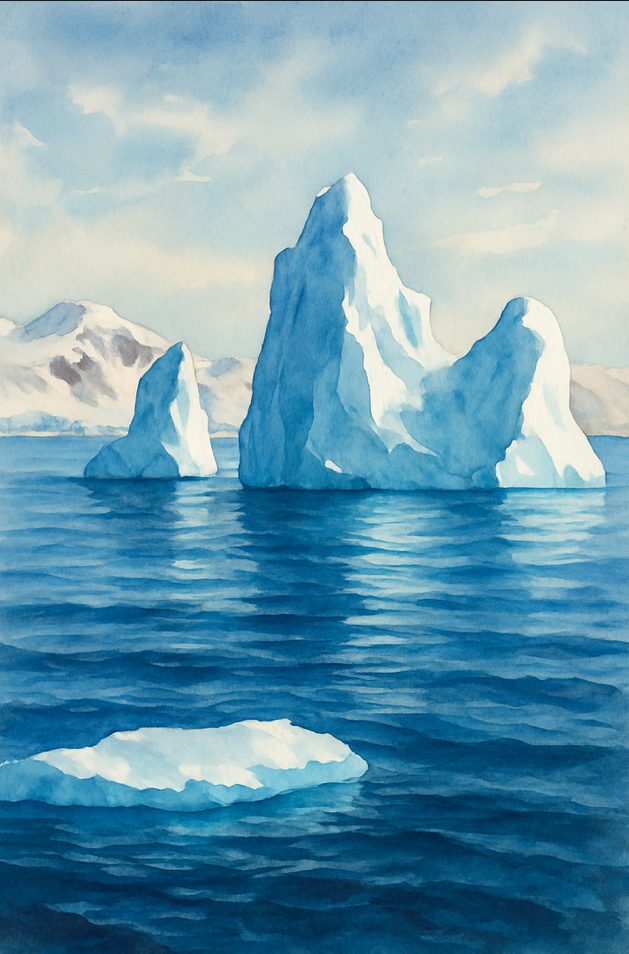
Distinctive: This ocean stores carbon and is linked by the Antarctic Circumpolar Current.
Connected to the global system: It helps explain how ocean circulation can move heat and carbon through the global climate system.

Special
Cyclone illustrates the principle because warm ocean water supplies energy for powerful storms.
Threat
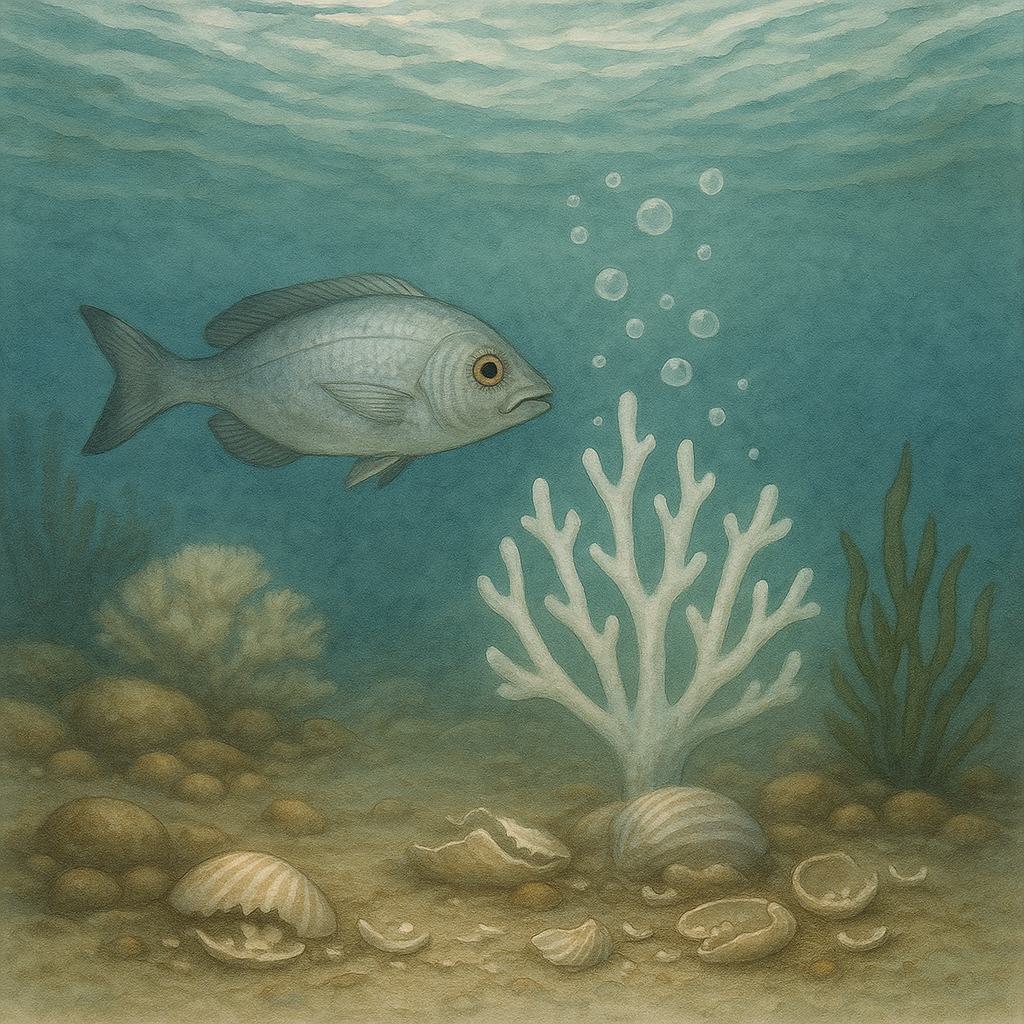
Ocean Acidification shows how additional atmospheric carbon dioxide can change seawater chemistry and affect shell-building organisms.
Adapted from the NMEA Grades 6–8 Principle 3 CFD (2021, handbook page 49). Source notes distinguish the original concepts from qualified adaptations. Classroom tasks and platform links are Blue Biome teaching suggestions.
The notes below paraphrase the English NMEA source. They also explain qualified adaptations and corrected references.
Ocean moisture contributes substantially to land rain, but origins and recycling differ regionally.
Printed P6 A4 does not exist; P6 B4 covers ocean evaporation and freshwater.
Read the explanationDistinguish ENSO phases and storm types; avoid the blanket claim that all storms share a tropical mechanism.
Read the explanationDistinguish ENSO phases and storm types; avoid the blanket claim that all storms share a tropical mechanism.
Read the explanationDistinguish ENSO phases and storm types; avoid the blanket claim that all storms share a tropical mechanism.
Read the explanationPreserve carbon uptake without repeating the sheet’s 50% as a current estimate. NOAA’s 2021 outreach gives an estimated 25%; definitions and timescales matter.
Read the explanationHeat, evaporation, condensation and circulation
Temperature patterns, ENSO and prediction
Carbon, photosynthesis, chemistry and climate